Wednesday, November 12, 2014

Millions of Cats!


Jerusalem reminds me of a children’s story that I remembered so fondly, I bought it for my own children and have a copy just in case I’m someday blessed with grandchildren to read to.  Millions of Cats is a story of a very lonely, elderly couple.  The wife decides that if they had a cat to love things would be wonderful so her dear husband sets out to find the perfect, beautiful, feline companion.   After a while, he comes to a place where he discovers, “Cats here, cats there, cats and kittens everywhere.  Hundreds of cats, thousands of cats, millions and billions and trillions of cats.”  Kind of like Jerusalem.    


Some are friendly, some not so much, some skinny, some not so much, and no, it is not because of crazy cat ladies gone wild feeding them, although I do admit to feeding several here on campus, and I know a tender hearted school guard who feeds upwards of 50. 


Coffee Shop buddy
Winnie, my 'window' buddy

The most reliable story behind the cat population is one that is not new.  Cats were not so prevalent in Israel until sometime in the 30’s when some bright someone got the “novel” idea to bring them in to combat the rat problem.  You would think that we would learn somewhere along the way that introducing animals and plants to places where they do not occur naturally is not the smartest idea.  Think of people moving to the desert regions to escape allergy problems bringing their favorite trees, flowers, and pollen along, rabbits in Australia and Russian Olives in central Illinois, to name a few examples.

No one seems to know how many cats are roaming the streets in these parts, some estimate about two million.  Wow.  I love cats, but I’m sentimental about them and think even barn cats need love, right? And care? And happily I’m not alone.  There are several groups in Israel who do what they can to spay, neuter, and inoculate the cat population including, as of last year, the government.    Meow Mitzvah Mission of Israel is one group that works to provide long-term, ethical solutions for reducing and controlling the street cat overpopulation.   Once the cats have received their “breeding intervention” the vet clips the tip of the left ear, the international symbol that the cat has been cared for.  


As the years pass the theory is that natural attrition will cause the wild population to decrease, and then perhaps become manageable or nonexistent.  


That’s what happened in the story, but not quite in the same way.  When the little old man went home he was followed by ALL of the many, many cats.  His wife, a wise woman realized they couldn’t care for all of them and so suggests the cats decide by asking “Which one of you is the prettiest?”  This naturally causes a cat fight of Epic proportions, frightening the couple who run back into the safety of their house.  When all is quiet they emerge to find only one skinny little unattractive cat who turns out, with a little food and love, to be exactly the cat they’d wanted.

Tel Aviv Graffiti cats
So, while I’m here I’ll feed my little friends when they show up for dinner, They're generally cuter than rats, and a lot friendlier. 


Tel Aviv carved cat
http://www.meowmission.org/


Saturday, November 8, 2014

It is well with my soul.

When peace, like a river, attendeth my way,
When sorrows like sea billows roll;
Whatever my lot, Thou hast taught me to say,
It is well, it is well with my soul.

Many of us have sung this hymn time and again, and as hymns do, it has drawn from us whatever healing or assurance we needed or wanted at the time.  “It is well with my soul,” is a universal desire, is it not?  But do you know the story behind the hymn? 

Horatio Spafford, his wife Anna and their four daughters lived in Chicago where he was a prosperous lawyer, a Presbyterian church elder described as devout, and real-estate investor.  The Spaffords were active in the abolitionist crusade, friends and hosts to many reform movements and their leaders, including Frances Willard of the National Women’s Christian Temperance Union and Dwight Moody who we remember as one of those igniting a religious revival in the US and Europe.  In the spring of 1871, the Great Fire of Chicago, decimated the city and by the end of the year had destroyed Spafford’s sizable real-estate investments. 

In 1873, the family was going to vacation in Europe but Horatio was delayed at the last minute; Anna and their daughters went ahead as planned on the SS Ville de Havre.  On November 21st, their ship was rammed and sunk.  Anna, the only one of the family rescued, sent a cable to her husband saying only, “Saved alone. What shall I do…”

He booked passage immediately to reunite with his wife (can you imagine, booking passage and the travel time that entailed?)  As the ship approached the spot where his daughters had died, the captain notified Horatio and in that place he wrote the words to the hymn we sing today.  Imagine all he’d lost and yet he found comfort.  A letter written to his sister shared, “On Thursday last we passed over the spot where she went down, in mid ocean, the waters three miles deep. But I do not think of our dear ones there. They are safe, folded, the dear lambs.” (1)

Spurred by what has been referred to as a Messianic fervor, a belief that Jesus’ return was imminent and so the work of paramount importance, in 1881, Anna and Horatio with a small number of other Americans (the Overcomers) traveled to Jerusalem to create a Christian Utopian society, later called the American Colony, and grew a variety of philanthropic ministries including, hospitals, orphanages, and ‘soup kitchens’ that remain in some form today. 

I’d read the stories years ago, and I've sung the hymn countless times, but last week, the Horatio’s became real to me when I saw the name in the Protestant Cemetery in the Old City of Jerusalem. 


In a time when missionaries likely never returned to the places they called home;  when bringing your coffin with you into the mission field was not unheard of; after the heartbreaking tragedies that the Spaffords had endured, their love of God and desire to bring that love to others and with it the saving knowledge of Jesus Christ carried them through.  From Chicago to Jerusalem and then home.  


Will you ever sing this hymn in quite the same way, ever again?  

When peace, like a river, attendeth my way,
When sorrows like sea billows roll;
Whatever my lot, Thou hast taught me to say,
It is well, it is well with my soul.


(1) The Prized Possession: Finding Hope, Worth, and Purpose in a Wounded World ; It Is Well, Jill Schaible, pg 150.  

Saturday, October 25, 2014

Sukkot


“On the first day you shall take the product of Hadar trees, branches of palm trees, boughs of leafy trees and willows of the brook” (Leviticus 23:40)   “You shall live in booths seven days; all citizens in Israel shall live in booths, in order that future generations may know that I made the Israelite people live in booths with I brought them out of the land of Egypt” (Leviticus 23:42-43)
Restaurants set up for customers 
on balconies and patios


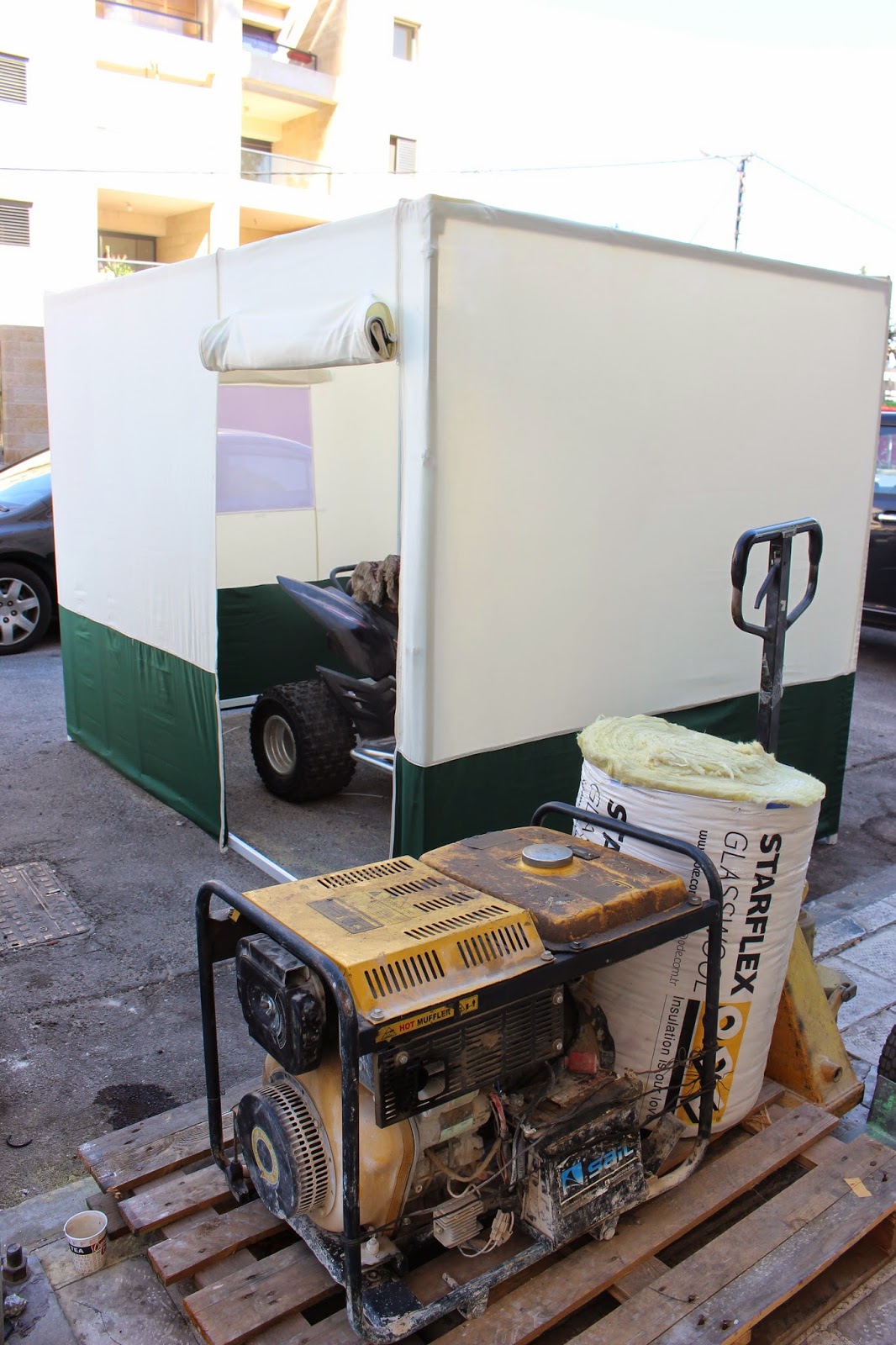
These “hastily” built booths starting springing up about a week before the Sukkot Festival began.


In yards and open spaces everywhere.  In balconies, and roofs, in front of restaurants and in alleyways.  Many made with what looks like plywood, sheets, some in plastic over p.v.c. frames.  People who have made Aliyah, return to Israel, frequently reuse the shipping container that brought their
possessions to their new home, and some use cardboard.   

Sukkot is one of the three pilgrimages the Israelites made to the Temple and is still one of the three major holidays celebrated nationally.

500 Shekel for a Succot of your own
from the "Dollar Store" 
from the Hardware store
in our building 
In the courtyard at
the Student Village 


My intent is not to try to teach you about Sukkot, I’m sure many of you already know, and I know the dialogue group in Houston had an opportunity recently to learn about the holiday, its history and celebration.  I just wanted to share some of the booths that sprang up in Jerusalem. 
Chag Sameach!  (Happy Holiday!)


Saturday, October 18, 2014

Window Shopping

I think I've walked past this little shop in the city center maybe seven or eight times since I've been here. It’s around the corner from the Light Rail and bus stops, up from the book store and down the street from the Aroma coffee shop.   Just one of the myriad of shops in the warren of streets and alleys off Jaffa and King George, but kind of sad and lonely.  The smell reminds me of the shoemakers shop on Teutonia Avenue in my old neighborhood growing up in Milwaukee.  A leather crafter, local guy, I've never see anyone coming in or going out.  

I keep coming back to look at one purse in particular, hanging there in the window, hoping someone had bought it because, well, I really wanted it and I was afraid to find out that I couldn't afford it.  I would just stop and look and enjoy the fragrance of real leather wafting through the door, the real reason I used to walk through the Wilson’s Leather store in Carbondale, I love the smell of leather.  I felt a little like a stalker, trying to catch a glimpse of the object of my desire.  Ok, sorry, that was a little creepy.

Today after church I wandered down from the Jaffa Gate to the shops, just to look, not to buy, and I found myself looking at purses here and there.  Imitation leather mostly or canvas, some day packs mostly from China, go figure. I could survive without a purse, I have a great backpack for work days, but on those days when I’m just exploring it would be nice to have something smaller, nicer.  Oh heck, it’s a girl thing, I want a purse.  But I’m also frightfully frugal.  I didn't really want to spend 100 shekel on an imitation leather bag, or 160 for another backpack or a canvas bag.  If I’m going to spend money on something I don’t really need, I want it to be something that will last and I can take home with me.  Something that I really like, and want!

So, here I am again.  I’m in front of the little store, telling myself that I really don’t need a purse, not the one in the window, or, wait a minute, not that one in the shop either, or the one next to it.  Nuts, I’m in the store and the really nice man looks so happy that I've come in.   He’s turned down the radio and turned up the lights. I tell him rak anglit, (I only speak English) and he says “how fortunate for me.”   Did I mention he is really nice?  He proceeds to tell me that he only uses real leather that is left over from making furniture, (at this point I am holding one of the bags and thinking how amazing a couch covered in this would be).  He says that he will reduce any price by 10% and then prices are negotiable.  I admit to him that I am not good at bartering, and he says “That’s ok, I will give you a good price.”   

So I decide that the bag in the window, the one that has been calling to me all this time is the one that I want.  He asks if the strap is long enough and switches it with one that is longer AND included the shorter strap so I can use either one as I like.  He gives me more than a 10% discount and I leave the store a happy shopper.  As I leave he turns the lights down and the music up, and I think, we’re both happy.


I have always preferred to shop locally.  I love supporting local crafts people and companies.  I won’t shop on Black Friday, but love Small Business Saturday, so this made my day, week, heck, maybe year. Plus, I have a lovely memento from Jerusalem.


Saturday, October 11, 2014

Humans of New York and the World

“When you are a child, and you walk outside, and see that your neighbor’s house is gone, it puts something in you deep down. All the small children have fear. It’s always with us. Weddings, graduation parties, these are happy events. But something is always missing. We always feel it. Life is very complicated now. There are checkpoints and police harassment. We live like second-class citizens. The Arabs are afraid of the Israelis. The Israelis are afraid of the Arabs. Arab children are afraid of bombs. Israeli children are afraid of rockets. And it’s not like one side can win. The Israelis can never kill all the Palestinians. The Palestinians cannot kill all the Israelis. Only peace can end it. I’d say eighty percent want peace. The rest are crazy religious.”  Humans of New York Oct 2 (Jerusalem)

Just before I came to Israel I was introduced to a Facebook page called Humans of New York.  If you haven’t heard of it, I recommend a visit.  It is listed as an Arts and Humanities website, but I find that is it much more.  In the description, Brandon, the founder explains, “I started HONY because I thought it would be really cool to create an exhaustive catalogue of New York City's inhabitants, so I set out to photograph 10,000 New Yorkers and plot their photos on a map. Somewhere along the way, I began to interview my subjects in addition to photographing them. And alongside their portraits, I'd include quotes and short stories from their lives.”

Humans of New York has become a daily reminder for over six million followers on social media, that everyone has a story, and those stories, captured in photos and quotes are sometimes happy, sometimes sad, always moving.  Currently Brandon is finishing up a 50 day trip to 10 countries, ending here in Israel, including the story above. 

What a profound reminder of why I am here, and why the Hand in Hand schools are so vitally important, not only for Israel, but truly for the world.  This model is another, better way to deal with the evil of hate and division. 

Just before the start of what was to become the First Gulf War, another Navy wife friend confided in me that she couldn't understand why she was completely indifferent about her husband’s deployment and possible death.  His job in the military required him to have hands on, front line duties that she believed should have caused her some concern.  In her defense, she grew up in Belfast, Northern Ireland.  She had shared stories of growing up that included bombings and death, walking to school and seeing bodies hung from lamp posts, watching neighbors’ homes burned to the ground.  I would say that it ‘put something in her, deep down’ that changed the way she dealt with life.

The universal problem of evil is easier to see in some places than others, but the effects are profound in those who experience it.  Once planted, the seeds are hard to stop.  Isn't it time we stopped planting those seeds of fear and division? Isn't it time we found another way?

http://www.timesofisrael.com/jews-and-arabs-take-a-walk/


http://www.humansofnewyork.com/

Friday, October 10, 2014

Mail Call


We take so much for granted in the United States.  Clean water, television, Wal Mart Superstores and regular mail delivery.
 
I have a mail box here at the university, and it is conveniently located in the building right next to the one I’m staying in.  I have gotten mail, and it works just fine. I open the box, retrieve my mail and do a little happy dance.  If I was only expecting letters, however, I would have missed out on a whole adventure in postal delivery, and would have left here to return, still grumpy that our mail delivery is sometimes less than we would like.  Buck up anti post office crowd, for whatever a stamp costs today, we’re still getting a deal!

Ok.  This post is not an attempt to defend the US Postal Service (no pun intended).  If you know me, you already know where I stand on that issue.   But like many things here, getting your mail, can be, well, complicated.

As I said, I have a mail box here at the Student Village, and mail is delivered Sunday through Thursday, but only letters.  In the housing office here at the Village, there is a dry erase board that lets students know that there is a package waiting for them; it boldly announces, “Your package is here” with the lucky student’s name written below.  I asked the other day if they would put a notice in my mail box when my eagerly anticipated packages arrived or should I just keep checking the board.  The answer?  Oh no, the only packages they hold at the office are those that come via delivery companies like UPS, or FedEx; mail parcels come through the local Israeli mail system.   Here is where the adventure begins. 

First I had to find the French Hill post office, no small matter since I can’t just look it up in the phone book (come to think of it, I haven’t even seen a phone book since I've been here) and it was nearly impossible to find online.  The ‘beginning’ directions I was given by the nice lady in housing had me turning right on the first road after the grocery store, then left, then just ask for the post office, or if I remembered the Hebrew word, the dohahr.  Yeah, no. 

In the process of searching google for the location, I learned many things about the postal system here.  First off, I’m fortunate to have a local post office at all.  One neighborhood nearby has none, and another has one, but it is only open sporadically.  Delivery is also problematic in some areas especially in East Jerusalem, where a lack of street signs and numbered houses makes it difficult to impossible for deliveries to be made at all.  It has actually become a civil rights issue, and last year a case was brought before the Supreme Court (not to be confused with the Supreme Court in the US).  Imagine, people pay their taxes and expect a service, sound familiar? 

So, I found a street address, “visited” it on google maps for better directions and headed out on my new “find it before you need it” routine.  Number 2 Abba Berditchev was not immediately visible.  Number 4 was the first building on the street and it wasn't a post office.  Taking a leap, I rang the bell and the lovely couple who lived there, directed me down and around to the back of the building, where, indeed there is a post office.  Success! So now I wait for the notice in my mail box that tells me my package has arrived. 


Had to have this translated for me! Open Hours


And by the way?  It turns out to be about a 10 minute walk from the dorms.  How do they do that?

Friday, October 3, 2014

Ammunition Hill

Every time I take the #34 bus I pass Ammunition Hill. Whenever I take the light rail I pass Ammunition Hill.  The other day, I realized it was more than a scheduled stop, the name of a neighborhood or a street.  Ammunition Hill is an historic location with a museum open to the public, and it’s in the neighborhood, so, I decided to visit last Friday. It seems that Ammunition Hill played a pivotal role the “Six Day War” as did Mt Scopus and the Hebrew University where I am living. 


Much like the Golan Heights (although visiting the heights is not generally recommended and there is no formal museum) the battle ground that is Ammunition Hill has been preserved as a living museum.  The bunkers and connecting communications tunnels have been preserved so that all can see the precarious yet advantageous location from which the battle was fought.  Standing on the top of the hill, the panorama is breathtaking and while you can no longer see Mt Scopus, it is possible to imagine the scenes that took place here not so long ago


For 12 shekels the museum offers an incredible 20 minute video that captures with photo, film, narration, audio clips and an interactive, computer assisted diorama, a trip back to the fight, complete with drawn battle lines and troop movements.  As the video plays. the battle rages before you, the troops move, the land is divided, redivided, captured and secured. The virtual tour lacks the emotion that comes with walking beside the tunnels, but it does good job capturing the scenes than my camera. 
http://www.g-h.org.il/en/tours/virtual


I've heard it said that the “Six Day War” is likely the most poorly named war in history.  The battle took six days, but the war continues. 


Like so much of history, if we forget it, if we ignore it, if we choose to blithely move on, it will repeat.   This is why we have museums like the one on Ammunition Hill.